
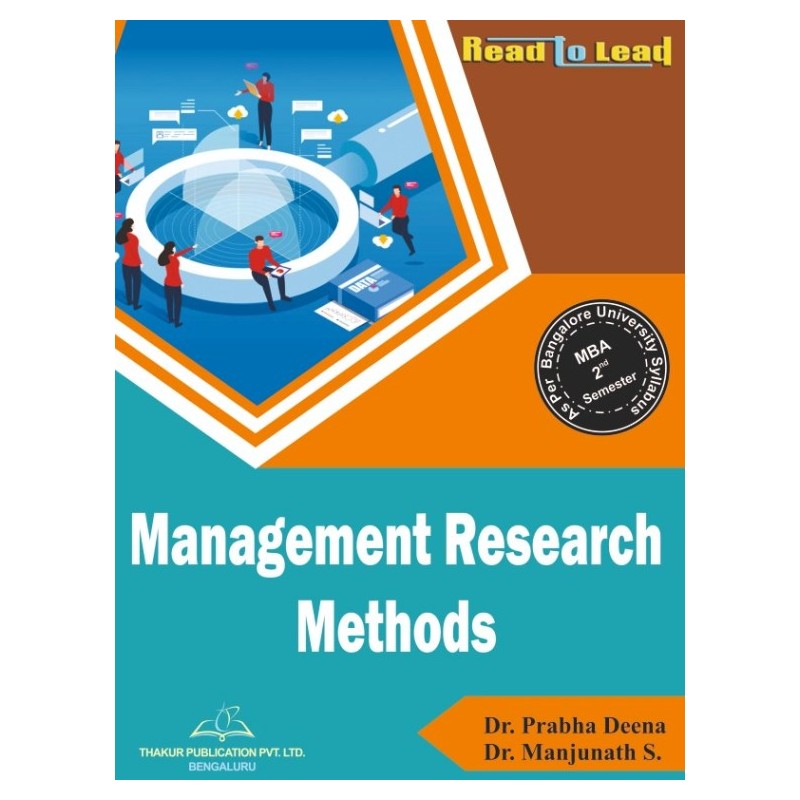


ISBN - 978-93-5480-482-3
Authors - Dr. Prabha Deena , Dr. Manjunath S.
Syllabus
Course Code: 2.2
MANAGEMENT RESEARCH METHODS
Module 1: Business Research 8 Hours
Meaning, Objectives, Purpose, Types, Scope and Significance of Research in Business and Industry. Criteria for Good Research, Ethics in Research. Research Process - Steps in Research, Identification and Formulation of Research Problem, Extensive Literature Review, Research Gap, Statement of the Problem, Need for the Study, Variables- Meaning and Types. Theoretical Framework, Research Questions. Deductive and Inductive Logic.
Module 2: Formulation of Research Problem and Hypotheses 10 Hours
Identifying and Formulating Research Problem, Diagnosis of Symptoms and Problem. Setting Research Objectives. Doing Review of Literature – Purpose, Methods. Hypothesis – Meaning, Purpose, Sources, Characteristics of Hypotheses, Types of Hypotheses, Formulation of Hypothesis.
Module 3: Measurement and Data Collection Concepts 12 Hours
Sample Design, Steps in Sampling Process, Sampling Methods – Probability Sampling and Non- Probability Sampling, Sampling Error, Criteria for Good Sample, Determining Sample Size (Infinite and Finite). Measurement – Types of Scales, Scaling Techniques.
Meaning of Primary and Secondary Data, Primary Data Collection Methods - Observations, Survey, Interview and Questionnaire, Qualitative Techniques of Data Collection, Questionnaire Design – Meaning - Process of Designing Questionnaire. Secondary Data -Sources – Advantages and Disadvantages.
Measurement and Scaling Techniques: Basic measurement Scales-Nominal Scale, Ordinal Scale, Interval Scale, Ratio Scale. Attitude Measurement Scale - Likert’s Scale, Semantic Differential Scale, Thurstone Scale, Multi-Dimensional Scaling. Case Study as per the Chapter Needs.
Module 4: Data Analysis 12 Hours
Data processing – Editing, Coding, Tabulation, Normality and Stationary Test, Pictorial and Graphical Presentation of Data, Parametric and Non-Parametric Hypothesis Testing, Hypothesis Testing Using Statistical Tools Such as Descriptive Statistics, Chi–Square, t- test, ANOVA, Correlation and Regression.
Module 5: Report Writing and Presentation of Results 8 Hours
Classification and Tabulation, Research Presentation, Types of Report - Research Proposal, Research Report. Format of a Report- Layout, Precautions. Citation and Referencing.
Module 6: Introduction and Application to Business Analytics 10 Hours
Data – Information – Intelligence – Knowledge Approach, Types of Analytics, Types of Digital Data, Sources of Data, Importance of Data Quality, Looking at Data from Many Perspectives, Evolution of Business Analytics, Business Analytics Process, Business Analytics Architecture and Framework. Analytics in Business Support Functions, Analytics in Industries – Sports Analytics, Social Media Analytics, Social Networking Analytics, Recommendation Systems.
Specific References
ISBN - 978-93-5480-482-3
Authors - Dr. Prabha Deena , Dr. Manjunath S.