


Click below to Buy E-Book Edition:
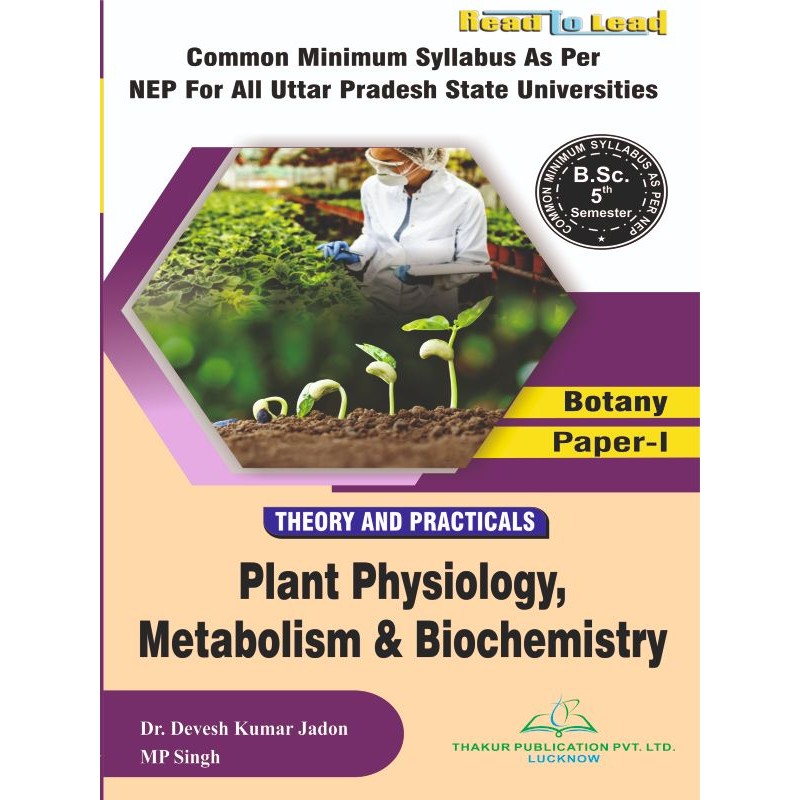
Authors : Dr. Devesh Kumar Jadon , MP Singh
ISBN : 9789357552721
Syllabus
Course Code: B040501T
Plant Physiology, Metabolism & Biochemistry
|
Unit |
Topic |
No. of Lectures (60hrs) |
|
I |
Plant Water Relation, Mineral Nutrition, Transpiration and Translocation in phloem Importance of water, water potential and its components; Transpiration and its significance; Factors affecting transpiration; Root pressure and guttation. Criteria of essentiality of elements; Role of essential elements; Symptoms of mineral deficiency in major crops, Transport of ions across cell membrane, active and passive transport, Composition of phloem sap, girdling experiment; Pressure flow model. |
7 |
|
II |
Carbon Oxidation Krebs cycle, Glycolysis, fate of pyruvate- aerobic and anaerobic respiration and fermentation, regulation of glycolysis, oxidative pentose phosphate pathway, oxidative decarboxylation of pyruvate, regulation of Krebs cycle, mitochondrial electron transport, oxidative phosphorylation, ATP-Synthetase, Chemiosmotic mechanism, P/O ratio, cyanide-resistant respiration, factors affecting respiration. |
7 |
|
III |
Nitrogen Metabolism Nitrate assimilation, biological nitrogen fixation (examples of legumes and non-legumes), Physiology and biochemistry of nitrogen fixation, Ammonia assimilation (GS-GOGAT), reductive amination and transamination, amino acid synthesis. |
8 |
|
IV |
Lipid Metabolism & Photosynthesis Lipid Metabolism: Synthesis and breakdown of triglycerides, -oxidation, glyoxylate cycle, gluconeogenesis and its role in mobilization of lipids during seed germination, -oxidation. ; Photosynthesis: Pigments, Action spectra and Enhancement effect, Electron transport system and Photophosphorylation, C3 & C4 photosynthesis, CAM- Reaction and Significance |
7 |
|
V |
Plant Development, Movements, Dormancy & Responses Developmental roles of Phytohormones (auxins, gibberellins, cytokinins, ABA, ethylene) autonomic & paratonic movements, Control and Coordination in plants, Photoperiodism (SDP, LDP, Day neutral plants); Phytochrome (discovery and structure), red and far red-light responses on photomorphogenesis, Seed physiology & Dormancy, Vernalization & Senescence |
8 |
|
VI |
Biomolecules Carbohydrates: Nomenclature and classification; Role of monosaccharides (glucose, fructose, sugar alcohols – mannitol and sorbitol); Disaccharides (sucrose, maltose, lactose), Oligosaccharides and polysaccharides (structural-cellulose, hemicelluloses, pectin, chitin, mucilage; storage – starch, inulin).
Lipids: Storage lipids: Fatty acids structure and functions, Structural lipids: Phosphoglycerides; Lipid functions: cell signals, cofactors, prostaglandins, Introduction of lipid micelles, monolayers, bilayers |
8 |
|
VII |
Proteins: Structure of amino acids; Peptide bonds; Levels of protein structure-primary, secondary, Ramchandran plot,tertiary and quaternary; Isoelectric point; Protein denaturation and biological roles of proteins. Nucleic acids: Structure of nitrogenous bases; Structure and function of nucleic acids, Nucleic acid denaturation & Re-naturation , MiRNA |
7 |
|
VIII |
Enzymes: Structure of enzyme: holoenzyme, apoenzyme, cofactors, coenzymes and prosthetic group; mechanism of action (activation energy, lock and key hypothesis, induced- fit theory), enzyme inhibition and factors affecting enzyme activity, Allosteric enzymes & Abzymes. Phytonutrients, Nutraceuticals, dietary supplements and antioxidants. |
8 |
Specific References
Click below to Buy E-Book Edition:
Authors : Dr. Devesh Kumar Jadon , MP Singh
ISBN : 9789357552721
 Watch Book Review