
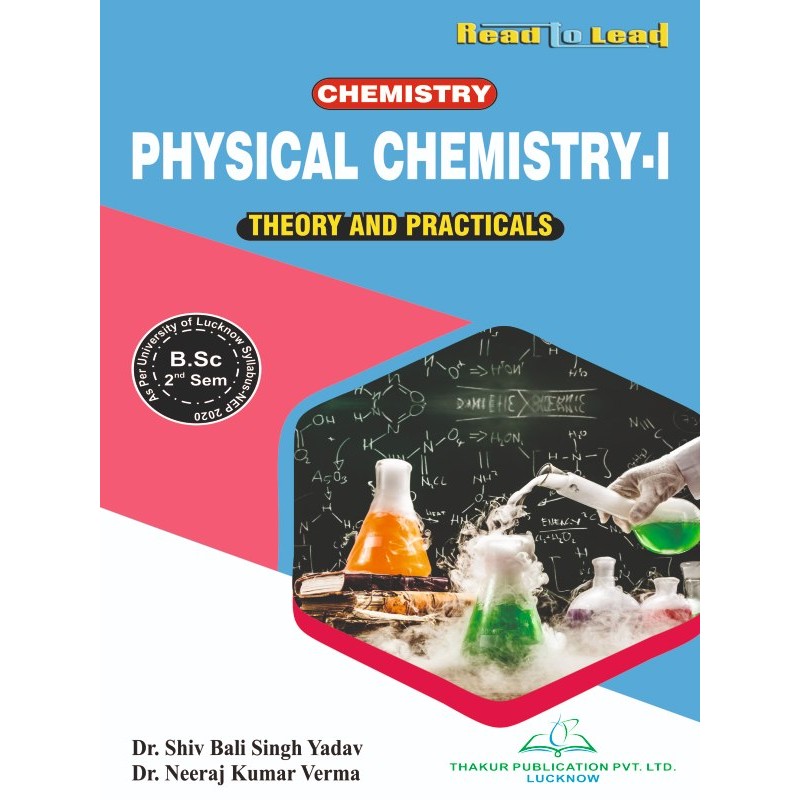


AUTHORS : Dr. Shiv Bali Singh Yadav , Dr. Neeraj Kumar Verma
ISBN : 9789357551717
Syllabus
Physical Chemistry – I
|
Unit-I
|
|
I. Mathematical Concepts: Logarithmic relations, curves scratching, equation of straight line and slopes, tracing of curves, differentiation of simple functions like x, ex, xn, sinx, logx; maxima and minima, partial differentiation. Integration of some useful/relevant functions; Permutations and Combinations. Factorials, Probability.
II. Computers: General introduction to computers, different components of a computer. Hardware and Software, input-output devices, binary numbers and its arithmetic; introduction to computer languages, Programming and operating systems. |
|
Unit- II
|
|
III. Gaseous State: Deviation of gases from ideal behaviour, van der Waals equation of State.
IV. Critical Phenomenon: PV isotherms of real gases, continuity of states, the isotherms of van der Waals equations, relationship between critical constants and van der Waals constants, the law of corresponding states, reduced equation of states.
V. Molecular Velocities: Qualitative discussion of the Maxwell's distribution of molecular velocities, collision numbers, mean free path and collision diameter. Liquification of gases (based on Joule Thomson effect).
VI. Liquid State: A qualitative description of intermolecular forces, structure of liquids,structural differences between solids, liquids and gases.
VII. Liquid Crystals: Difference between liquid crystal, solid and liquid. Classification, structure of nematic, smectic and cholestric liquid crystals. Thermography and seven segment cell. |
|
Unit- III |
|
VIII.Solid State: Definition of unit cell and space lattice. IX. Laws of Crystallography:
X. Diffraction-X-ray: Diffraction by crystals. Derivation of Bragg's equation. Laue’s method and powder method, determination of crystal structure of NaCl, KCl and CsCl XI. Colloidal State: Solids in liquids (sols): properties- Kinetic, optical and electrical; stability of colloids, protective action, Hardy-Schulz law, goldnumber. XII. Liquids in Liquids (EMULSIONS): types of emulsions, preparation. Emulsifier. XIII.Liquids in Solids (GELS): classification, preparation and properties, inhibition, general applications of colloids. |
|
Unit- IV |
|
XIV. Chemical Kinetics:
XV. Catalysis: Catalysis, classification of catalysis, characteristics of catalyzed reactions: |
Specific References
AUTHORS : Dr. Shiv Bali Singh Yadav , Dr. Neeraj Kumar Verma
ISBN : 9789357551717