- New
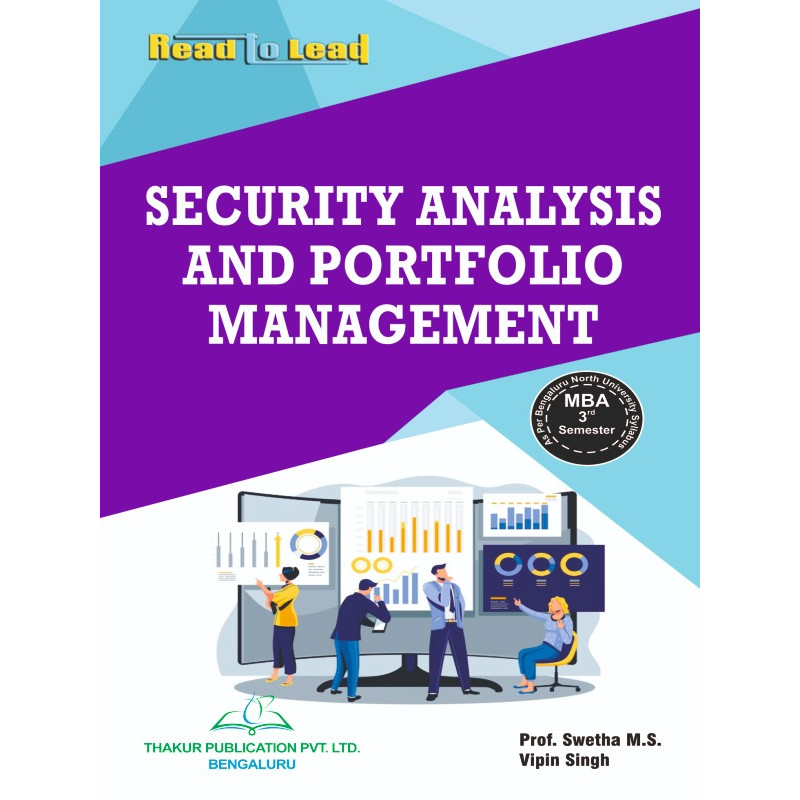

Authors : Prof. Swetha M. S., Mr. Vipin Singh
ISBN : 9789361802492
Tax excluded
PERSPECTIVE OF THE COURSE:
This course aims at developing an understanding of the changing domestic and global investment scenario in general and Indian capital market with reference to availability of various financial products and operations of stock exchanges. It aims at providing an in-depth knowledge of the theory and practice of portfolio management. It discusses the risk return trade-off of an individual investor, it also persists how investment in the securities market is evaluated based on Fundamental and Technical analysis, application of Modern Portfolio Theory, analysis of active and passive investment strategies, and measurement of portfolio performance. This course emphasizes on forces that affect the security market.
COURSE OBJECTIVES AND OUTCOMES OBJECTIVES:
● To understand the investment environment, different types of financial investment instruments and financial institutions. ● To provide insight about the relationship of the risk and return, theories of portfolio management and the tools and techniques for efficient portfolio management. ● To analyze and evaluate the fair value of stocks and bonds, explain the main factors affecting the values. ● Familiarize the students with the Fundamental, Technical and Behavioral aspects of diverse investment avenues ● To distinguish between active and passive investment strategies; assess the efficiency of portfolio management
OUTCOMES:
Upon successful completion of the course, students will be able to: ● Describe and to analyze the investment environment, different types of investment vehicles. ● Use the quantitative methods to calculate risk and expected return of various investment tools and the investment portfolio. ● Analyze and to evaluate returns of stocks & bonds for the investments using various models & theorems. ● Understand the stock using fundamental & technical and behavioral analysis in investment decision making. ● Distinguish concepts of portfolio theories and apply their principals in the process of optimal portfolio formation.
MODULE 1: INTRODUCTION TO INVESTMENTS, VALUATION OF RISK & RETURN
Concept of Investment, Investment Objectives and Constraints, Overview of Financial Markets & Instruments, Stock exchanges, SEBI, Market Indices and creation of index. Risk and Return: Revenue Return and Capital appreciation, holding period return, Calculation of expected return, Risk factors, risk classification, valuation of systematic risk, unsystematic risk, standard deviation, variance, & Beta (Theory & Problems)
MODULE 2: VALUATION OF BONDS & SHARES
Equity shares: Concept, Valuation, Dividend Valuation models. 2 phase, 3 phase & H models. Bonds: Bond features, Types of Bonds, Determinants of interest rates, Bond Valuation, YTM & Holding Period Yields, Bond Duration. Preference Shares- Concept, Features, Yields. (Theory & Problems)
MODULE 3: FUNDAMENTAL & TECHNICAL ANALYSIS OF STOCKS
Fundamental Analysis for determination of inputs to equity valuation, EIC Framework, Economic Forecasting Methods, Industry Analysis, Industry Life Cycle, Structural Analysis. Company Analysis (financials & non-financials). Technical Analysis: Dow Theory, Types of Charts, Price Patterns, Trends, Support and Resistance Levels, Indicators, RSI, Moving Averages, MACD, Breadth of the Market, Volume, Momentum. (Theory & Problems)
MODULE 4: MODERN PORTFOLIO THEORY & PORTFOLIO PERFORMANCE EVALUATION
Introduction to Portfolio Management – Measurement of Expected Risk and Returns of Portfolio, Markowitz Portfolio Theory, Efficient frontier, Sharpe’s Single Index Model, Optimal Portfolio Selection, Capital Assets Pricing Model, SML and CML, Arbitrage Pricing Theory, Introduction to Mutual Funds, Evaluation of Portfolio Performance – Treynor, Sharpe, Jensen ratios, Active & Passive Portfolio Management. (Theory & Problems)
MODULE 5: EMH AND BEHAVIORAL FINANCE
Introduction to Efficient Market Hypothesis, Random Walk Model, Forms of EMH. Behavioural Finance: Introduction, Definition and Scope, Traditional Finance vs. behavioural Finance, Importance of behavioural Finance in Modern Economics, Overview of Cognitive Biases and Emotional Influences in Decision-Making. Applications of Behavioural Finance: Personal Finance-Implications for individual saving, investing, and budgeting, Financial Market 93 Regulation-How behavioural insights can inform policy, Behavioral Asset Pricing-Understanding market prices based on behavioral factors (Theory only)