
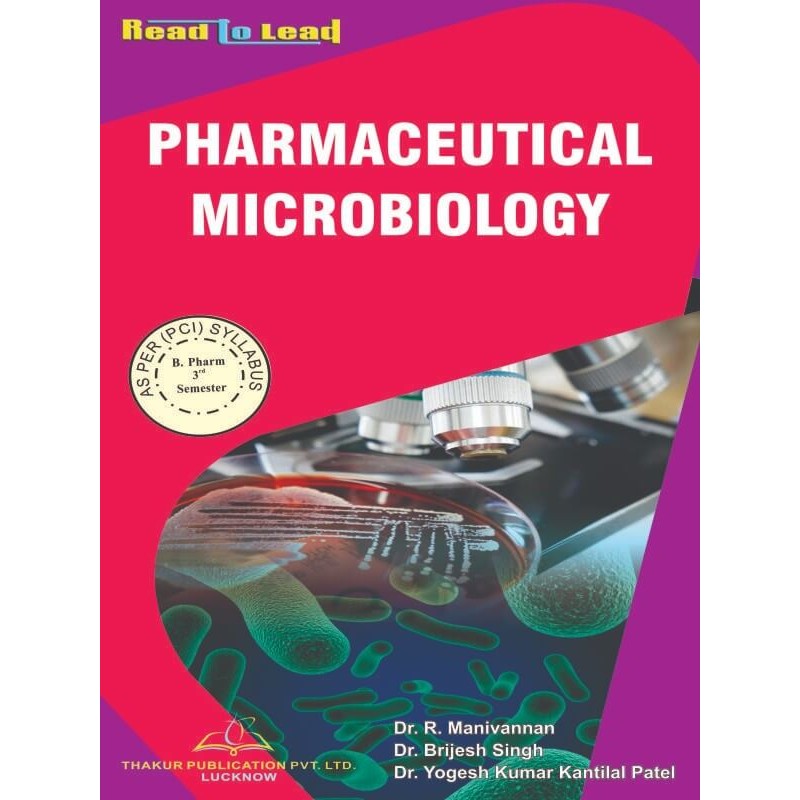
Authors: Dr. R. Manivannan, Dr. Brijesh Singh & Dr. Yogesh Kumar Kantilal Patel
For students pursuing B.Pharm 3rd Semester and focusing on Pharmaceutical Microbiology, this book is an essential study resource. Written by experienced professionals in the field, this comprehensive guide covers all the essential topics and concepts related to microbiology in an easy-to-understand format.
We are providing Pharmaceutical Microbiology b.pharm 3rd sem book as per PCI by Thakur Publication. Microbiology in pharmacy classified different types of phase contrast microscopy, dark field microscopy and electron microscopy.
B.Pharm.,Third SemesterAccording to the syllabus based on ‘Pharmacy Council of India’Syllabus(BP303T) PHARMACEUTICAL MICROBIOLOGYModule-1 (10 Hours)
Introduction, history of microbiology, its branches, scope and its importance.
Introduction to Prokaryotes and Eukaryotes.
Study of ultra-structure and morphological classification of bacteria, nutritional requirements, raw materials used for culture media and physical parameters for growth,growth curve, isolation and preservation methods for pure cultures, cultivation ofanaerobes, quantitative measurement of bacterial growth (total and viable count).
Study of different types of phase contrast microscopy, dark field microscopy and electron microscopy.
Module-2 (10 Hours)
Identification of bacteria using staining techniques (simple, Gram’s and acid fast staining) and biochemical tests (IMViC).
Study of principle, procedure, merits, demerits and applications of physical, chemical gaseous, radiation and mechanical method of sterilization.
Evaluation of the efficiency of sterilization methods.
Equipments employed in large-scale sterilization.
Sterility indicators.
Module-3 (10 Hours)
Study of morphology, classification, reproduction/replication and cultivation of Fungi and Viruses.
Classification and mode of action of disinfectants.
Factors influencing disinfection, antiseptics and their evaluation for bacteriostatic and bactericidal actions.
Evaluation of bactericidal and Bacteriostatic.
Sterility testing of products (solids, liquids, ophthalmic and other sterile products) according to IP, BP and USP.
Module-4 (08 Hours)
Designing of aseptic area, laminar flow equipments; study of different sources of contamination in an aseptic area and methods of prevention, clean area classification.
Principles and methods of different microbiological assay. Methods for standardization of antibiotics, vitamins and amino acids.
Assessment of a new antibiotic.
Module-5 (07 Hours)
Types of spoilage, factors affecting the microbial spoilage of pharmaceutical products, sources and types of microbial contaminants, assessment of microbial contamination and spoilage.
Preservation of pharmaceutical products using antimicrobial agents, evaluation of microbial stability of formulations.
Growth of animal cells in culture, general procedure for cell culture, Primary, established and transformed cell cultures.
Application of cell cultures in pharmaceutical industry and research.
PCI2021/Bpharm/03/3
67 Items
Specific References
ean13
9789387880726
New
Comments (0)
No customer reviews for the moment.
Your review appreciation cannot be sent
Report comment
Are you sure that you want to report this comment?
Report sent
Your report has been submitted and will be considered by a moderator.
Your report cannot be sent
Write your review
Review sent
Your comment has been submitted and will be available once approved by a moderator.
Authors: Dr. R. Manivannan, Dr. Brijesh Singh & Dr. Yogesh Kumar Kantilal Patel
For students pursuing B.Pharm 3rd Semester and focusing on Pharmaceutical Microbiology, this book is an essential study resource. Written by experienced professionals in the field, this comprehensive guide covers all the essential topics and concepts related to microbiology in an easy-to-understand format.
We are providing Pharmaceutical Microbiology b.pharm 3rd sem book as per PCI by Thakur Publication. Microbiology in pharmacy classified different types of phase contrast microscopy, dark field microscopy and electron microscopy.