
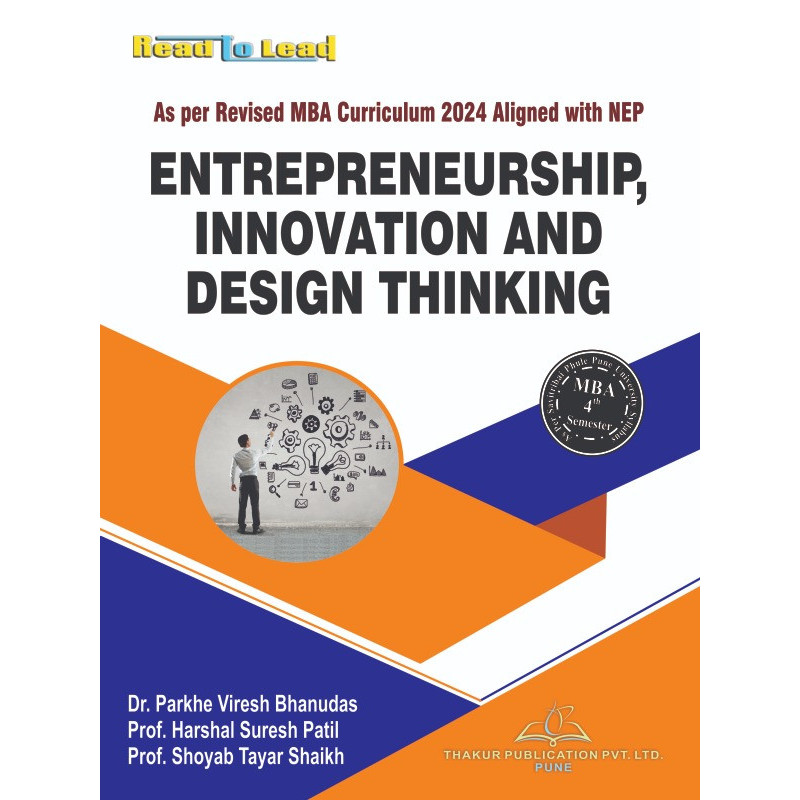


Authors : Parkhe Viresh, Prof. Harshal Suresh Patil,Prof. Shoyah Tayar Shaikh
ISBN : 9789372903850
Syllabus
GC 01: Entrepreneurship, Innovation and Design Thinking
UNIT-1
Entrepreneurship & Innovation – Definition, Objective and Features: Entrepreneurship; Difference between Entrepreneurship and Traditional Businesses; Entrepreneurs and Intrapreneurs; Corporate Entrepreneurship, Technological Entrepreneurship, Life Cycle of Startup, Focus on Valley of Death, Why Startups Fail?
Innovation: Culture of Innovation - Process and Types of Innovation – Continuous and Disruptive, Radical Innovation, Challenges in Innovation, Agile/Lean Innovation, Steps of Innovation Management, Idea Management System, Divergent V/s Convergent Thinking, Design Thinking and Entrepreneurship Creating Value through Innovation. Management of Innovation, Types of IPR (7 + 2)
UNIT-2
Entrepreneurial Theories and Entrepreneurial Environment, Entrepreneurial Development- Theories of Entrepreneurship; Successful Entrepreneurs and Their Traits; Types of Entrepreneurs; Entrepreneurial Environment PESTEL and Their Effects; Business Environment Analysis, Business Planning; Mid-career Dilemmas; Entrepreneurial Growth and Competitive Advantage; Changing Role of Entrepreneurs. Women Entrepreneurs, Entrepreneurship Development Institute; Entrepreneurship Development Programs (7 + 2)
UNIT-3
Design Thinking – Introduction, Definitions and Meaning; Design Thinking –as an Art and Science; Stages of Design Thinking –Empathise, Define, Ideate, Prototype and Test; Entrepreneurship Design Thinking, Need of Design and Design Thinking Writing the Problem Statement; Understanding Stakeholders and Users; Personas, Empathy Maps; Current Scenarios to Identify pain Points; Ideation and Storyboarding; Deriving Goals from Ideas; Future Scenarios and Moments of Max Impact; Prototyping (7 + 2)
UNIT-4
Design Thinking in Start-Up – 5 Stages Integration Empathise–Listening to People Involved and the End User Problems Realisation, Understanding User Needs: User Research Techniques, Observation, Interviewing, Surveys, Persona Mapping; Define– Identifying User Problems, Problem Statement Formulation, Reframing Problems; Ideate – Generating Ideas, Brainstorming Techniques, Mind Mapping, Scenarios - Finding the Solutions most Effectively; Prototype – Making the Samples to Launch, Different Types of Prototypes, Testing and Iterating; Test – Evaluating offerings, Usability Testing, User Feedback. Design thinking with AI (7 + 2)
UNIT-5
Opportunity Recognition & Business Models- Model of Opportunity Recognition (Corbett, 2005), Identifying Opportunities through Design Thinking, Market Research Basics, Value Proposition Canvas, Business Model Canvas (BMC), Minimum Viable Product (MVP): Lean Startup & Validation- Lean Startup Methodology (Eric Ries), Build-Measure-Learn cycle, Customer Validation, Metrics and KPIs, Agile Iteration. Teamwork and Collaboration. Business Model Failure: Reasons and Remedies. Sustainability, Innovation and Entrepreneurship. Emerging Technologies such as Artificial Intelligence, Augmented Reality, Virtual Reality. (7 + 2)
Specific References
Authors : Parkhe Viresh, Prof. Harshal Suresh Patil,Prof. Shoyah Tayar Shaikh
ISBN : 9789372903850