
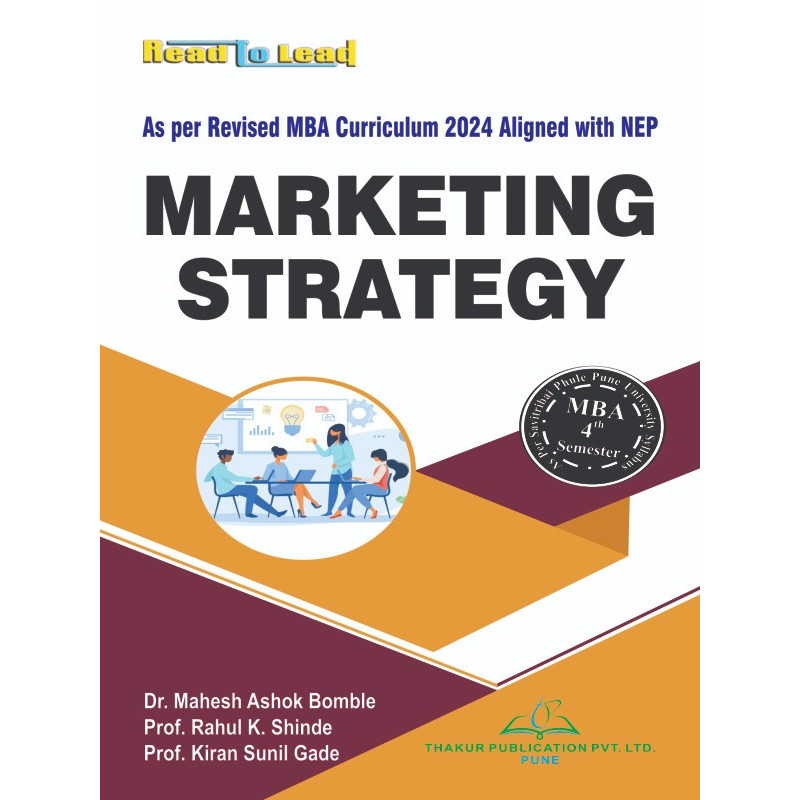


Authors : Dr. Mahesh Ashok, Prof. Rahul K. Sindhe, Prof. Kiran Sunil Gade
ISBN : 9789372905564
Syllabus
SC MKT- 02: Marketing Strategy
Unit 1: Introduction to Marketing Strategy:
Introduction to Marketing Strategy: Meaning and Definition of Marketing Strategy, The Role of Marketing Strategy in Business, The Evolution of Marketing Strategy. The Marketing Strategy Process: Steps in Developing a Marketing Strategy: Environmental Analysis, Setting Marketing Objectives, Identifying Target Markets, Crafting the Marketing Mix (4Ps), Implementing and Monitoring the Strategy. Business Strategy and Marketing Strategy Alignment: Corporate and Business-Level Strategies. Marketing Strategies Along Various Stages of PLC, Integrating Marketing Strategy with Overall Business Goals, Case Studies of Successful Strategic Alignment. [6+3]
Unit 2: Marketing for Customer Advantage & Value Creation
Definition and Importance: Defining Customer Value and its Significance in Marketing and Business Strategy. Generating and Using Customer Insight to Drive Strategy, Tools for Innovating New Values for Customers, Managing Customers for Experience, Managing Customers for Profit. Customer Value vs. Satisfaction & Loyalty: Difference between Customer Value, Satisfaction, and Loyalty. Measuring Customer Value: Exploring Qualitative and Quantitative Methods for Measuring Customer Value. Strategies for Innovating New Values for Customers: Proactive, Active, Reactive and Passive. Targeting Customers, Cognitive Marketing Strategy. [6+3]
Unit 3: Pricing – The Ultimate Marketing Strategy
Pricing Excellence, Strategic Pricing [4 C’s of Pricing - Customer, Costs, Competition, and Constraints], Pricing Maturity Model, Transformational Model. Centralized Versus Decentralized Pricing Options for Pricing Organizational Designs, Pricing Capabilities: Pricing Dimensions, Pricing Myths at the Organizational Level. Recent Trends in Pricing (AI & Gen AI, Volatility, Dynamic Pricing, Sustainability, Fairness), Competing Against Low-Cost Rivals, Pricing During Recession. [6+3]
Unit 4: Vibrant Scope of Marketing Strategy
Account Based Marketing, Data-Driven Marketing Strategy, Digital Marketing Strategies, Relationship Marketing Strategies, Distribution Strategy, Experiential Marketing, Innovation Marketing, Green Marketing, Retail Marketing Inbound Marketing Strategies – Online Marketing and Offline Marketing, Multilevel Marketing, Strategic Marketing in New Modern Era, Market-Innovation Strategy: Pioneering New Markets (type), Customer Centric Approach, Strategy Innovation, Brand Storytelling, Strategy Sustainability and Ethics, Strategy Community Engagement Strategies in International Markets, Emerging and Declining Markets. [6+3]
Unit 5: Executing Marketing Plan
Formulation, Reformulation of Marketing Strategies, the Control Process. Implementing and Evaluating Marketing Strategies: Key Performance Indicators (KPIs) and Metrics, Sustainable Competitive Marketing Advantages, Monitoring and Adjusting Marketing Strategies, Real-World Examples of Marketing Strategy Execution. Preparing Marketing Plan for Ed-tech, Automobile, Banking & Insurance, FMCG, and Food & Beverage. Presenting Marketing Plan, Marketing Decision Making with Reasons, Marketing Strategies to Compete Globally & Matching Recent Trends. [6+3]
Specific References
Authors : Dr. Mahesh Ashok, Prof. Rahul K. Sindhe, Prof. Kiran Sunil Gade
ISBN : 9789372905564