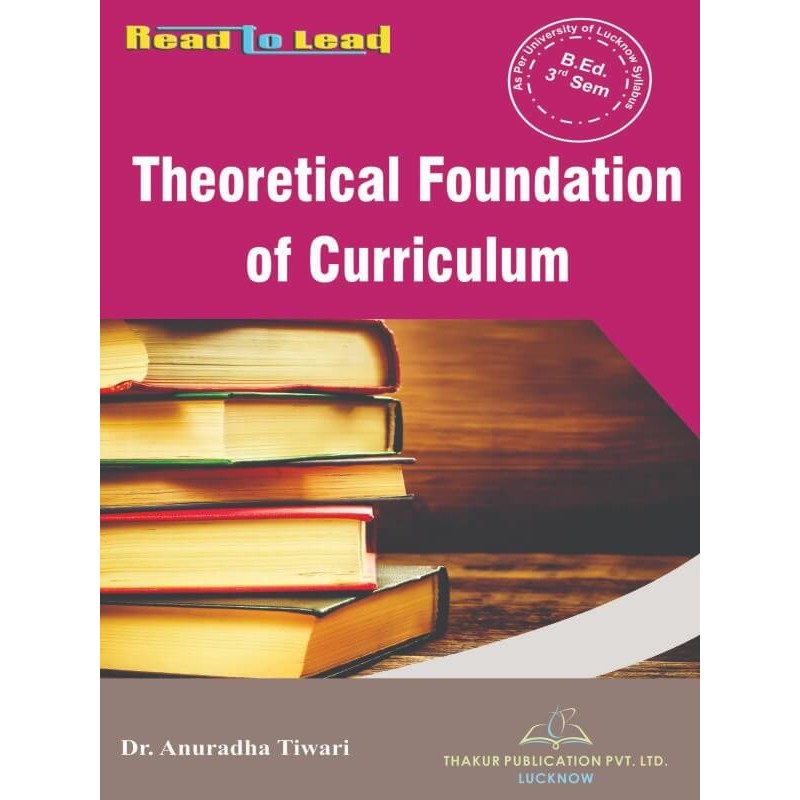
Paper II: Theoretical Foundations of Curriculum
Objectives:
The teacher will be able:
v To enable the learners to understand the basic concept of curriculum, syllabus and textbooks.
v To enable the learners to understand various types, methods, determinants and motives of curriculum development.
v To enable the learners to understand various curriculum practices in India and abroad.
v To enable the learners to design an innovative curricular model.
Unit I
- Curriculum: Concept, Meaning and Nature, Difference between Curriculum, Syllabus and Textbooks
- Types of curriculum: Learner centered, Teacher centered, Subject centered, Correlation, Core, Fusion, Accelerated, Enriched, Sandwitch, Crash, Disciplinary, Integrated, Interdisciplinary, Transdisciplinary, Mutidisciplinary.
Unit II
- Basis of Curriculum: Philosophical, Socio-cultural, Political, Psychological; Beliefs about Knowledge, Technological advancement.
- Determinants and motives of curriculum Development, Principles of Curriculum Construction; Selection, gradation and Organization of content.
Unit III
- Steps of curriculum Designing: Setting of objectives and learning experiences, Selection and organization of learning content and learning material, assessment and evaluation of learning, Modification and resetting of objectives.
- Various evaluation strategies: Formative and Summative evaluation, Semester & Trimester System, CCE(Continuous and Comprehensive Evaluation), CRT ( criterion-referenced test), NRT(Norm-referenced tests), CGPA(Cumulative Grade Point Average), GGPA(Graduate Grade Point Average)
Unit IV
- Models of Curriculum: Administrative Line Staff Model, Grassroot Model, Demonstration Model, Models of Teacher Education Curriculum in CIE (Delhi), Banasthali, Indore, Shantiniketan, NCF 2005 and NCFTE 2009.
- Ideas of Gandhi, Tagore, Gijubhai and Gurukul System on Curriculum