


Click to Buy E-Books:
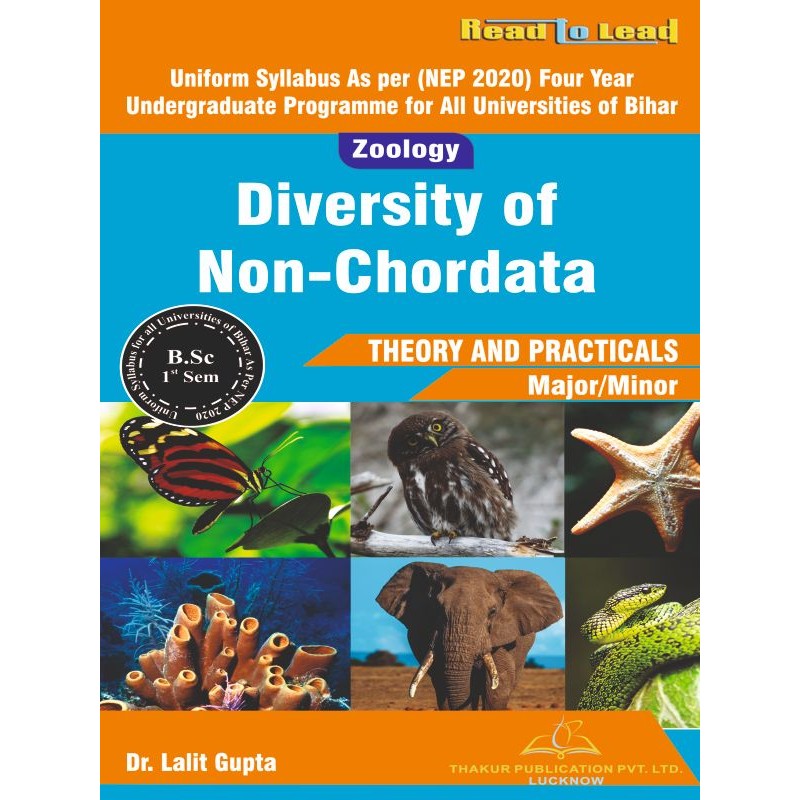
Buy Latest (Zoology) Diversity of Non-Chordata Major/Minor Book in English language for B.Sc 1st Semester Bihar State By Thakur publication.
AUTHOR : Dr. Lalit Gupta
ISBN : 9789357553605
Syllabus
|
MJC-1: Diversity of Non-Chordata (Theory: 4 credits) 40hrs |
||
|
Unit |
Topics To be Covered |
No. of Lectures |
|
1 |
1. Introduction to Non-Chordates: General characteristics and classification (up to order) of the following Phyla: Protozoa, Porifera, Cnidaria, Ctenophora, Platyhelminthes and Nemathelminths, Annelida, Arthropoda, Mollusca, Echinodermata. |
8 |
|
2 |
2.1 Protozoa: Structure and Life cycle of Paramecium, Plasmodium, Entamoeba histolytica, Trypanosoma, L. donovani |
10 |
|
2.2. Porifera: Spicules and Canal system in sponges; affinities of the Phylum |
||
|
3 |
3.1. Cnidaria: Structure and Life Cycle: Obelia, Aurelia |
10 |
|
3.2. Ctenophora: General organisation of Hormiphora; affinities of the phylum. |
||
|
3.3. Platyhelminthes and Nemathelminthes: Structure and Life cycle of Fasciola hepatica, Taenia solium, Ascaris lumbricoides. |
||
|
4 |
4.1. Annelida: Earthworm, Leech: Structure, locomotion, alimentary canal Reproduction. |
12 |
|
4.2. Arthropoda: Peripatus, Adaptive variations in insect mouth parts. |
||
|
4.3. Mollusca: Structure and Life Cycle: Unio Pila, Torsion and Detorsion in Gastropoda |
||
|
4.4. Echinodermata: Structure: Star fish; Larval forms in Echinoderms; Water Vascular System in Echinoderms |
||
|
|
Total |
40 |
Practical
|
MJC-1: Diversity of Non-Chordata (Practical: 2 credits) 20hrs |
|
|
Practical: |
|
|
1) |
Study of whole mount of Euglena, Amoeba, Paramecium, Monocystis; Binary fission and Conjugation in Paramecium. |
|
2)
|
Study of Sycon; T.S. of Sycon, L.S. of Sycon; Gemmule, Hyalonema. |
|
3)
|
Permanent stained preparation of spicules of sponges. |
|
4)
|
Study of Obelia, Aurelia, Metridium, Physalia. |
|
5)
|
Specimen/slide of any one Ctenophore. |
|
6)
|
Study of adult Fasciola hepatica, Taenia solium and Ascaris (male and female). |
|
7)
|
Study of Aphrodite, Septal nephridia and Ovary of Earthworm; Jaws of leech; Trochophore larva. |
|
8)
|
Study of T.S. through pharynx, gizzard, and typhlosolar region of earthworm |
|
9)
|
Study of Limulus, Scolopendra, Grasshopper, Phyllium, Praying mantis, and Palaemon, Sacculina, Cancer, Eupagurus, Apis, Musca, Salivary gland of Cockroach, Mouth parts of Mosquito. |
|
10)
|
Study of Chiton, Dentalium, Octopus, Glochidim larva. |
|
11)
|
Study of Asteria, Echinus, Antedon. |
Syllabus
|
MIC-1: Diversity of Non-Chordata (Theory: 2credits) 20 hrs |
||
|
Unit |
Topics to be covered |
No. of Lectures |
|
1 |
I. Introduction to Non-chordates General characteristics and classification (up to order) of the following Phyla: Protozoa, Porifera, Cnidaria, Ctenophora, Platyhelminthes and Nemathelminths, Annelida, Arthropoda, Mollusca, Echinodermata. |
5 |
|
2 |
2. Structure and life history of:- (i) Protozoa - Paramecium (ii) Porifera – Sycon |
4 |
|
3 |
3. Structure and life history of:- (iii) Cnidaria - Obelia (iv) Platyhelminthes - Fasciola (v) Aschelminthes – Ascaris |
5 |
|
4 |
4. Study of coelomates:- (vi) Annelida - Pheretima (vii) Arthropoda - Palaemon (viii) Mollusca - Pila (ix) Echinodermata - Asterias (x) Hemichordata - Balanoglossus |
6 |
|
|
Total |
20 |
Practical
|
MIC-1: Diversity of Non-Chordata (Practical) 10 hrs (1 credit) |
|
Practicals: 1. Study of whole mount of Euglena, Paramecium, Leishmania 2. Study of Sycon, Spongilla, T.S. of Sycon, L.S. of Sycon. 3. Study of Obelia, Aurelia, Gorgonia 4. Study of adult Fasciola hepatica, Taenia solium and their life stages 5. Study of Pheretima, Hirudinaria 6. Study of T.S. through pharynx, gizzard, and typhlosolar intestine of earthworm. 7. Study of Limulus, Palaemon, Apis. 8. Mouth parts of Mosquito and Cockroach. 9. Study of Pila, Unio. 10. Study of Asterias. |
Specific References
Click to Buy E-Books:
Buy Latest (Zoology) Diversity of Non-Chordata Major/Minor Book in English language for B.Sc 1st Semester Bihar State By Thakur publication.
AUTHOR : Dr. Lalit Gupta
ISBN : 9789357553605