
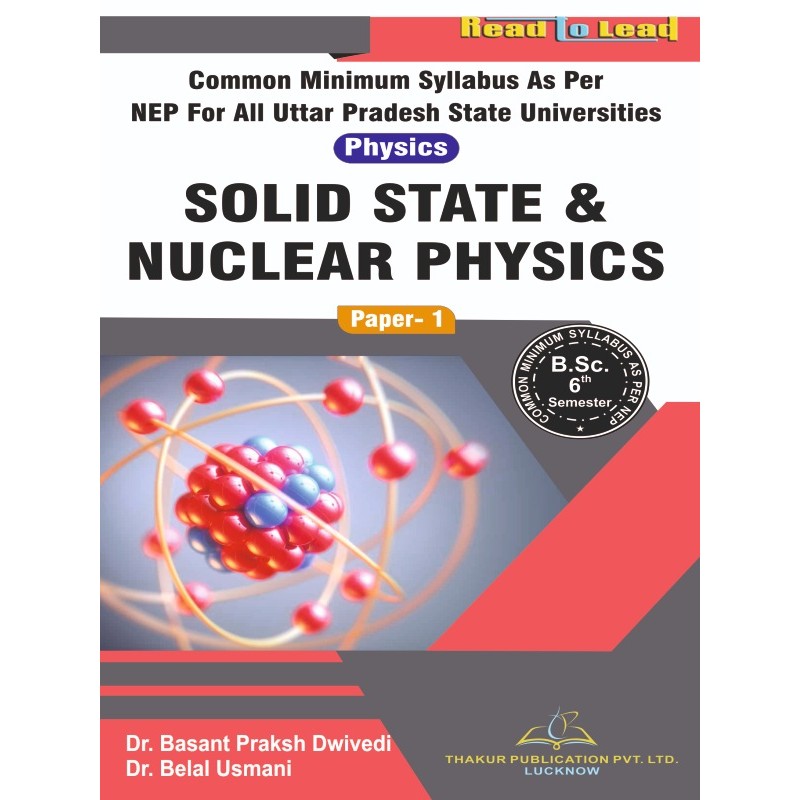


Click below to Buy E-Book Edition:
AUTHORS : Dr. Basant Prakash Dwivedi , Dr. Belal Usmani
ISBN : 978-93-5755-688-0
Syllabus
Physics
Solid State & Nuclear Physics
Course Code: B010601T
|
Unit |
Topics |
No. of Lectures |
|
|
Part A: Introduction to Solid State Physics |
|
|
I |
Crystal Structure Lattice, Basis & Crystal structure. Lattice translation vectors, Primitive & non-primitive cells. Symmetry operations, Point group & Space group. 2D & 3D Bravais lattice. Parameters of cubic lattices. Lattice planes and Miller indices. Simple crystal structures - HCP & FCC, Diamond, Cubic Zinc Sulphide, Sodium Chloride, Cesium Chloride and Glasses. |
07 |
|
II |
Crystal Diffraction X-ray diffraction and Bragg’s law. Experimental diffraction methods - Laue, Rotating crystal and Powder methods. Derivation of scattered wave amplitude. Reciprocal lattice, Reciprocal lattice vectors and relation between Direct & Reciprocal lattice. Diffraction conditions, Ewald’s method and Brillouin zones. Reciprocal lattice to SC, BCC & FCC lattices. Atomic Form factor and Crystal Structure factor. |
07 |
|
III |
Crystal Bindings Classification of Crystals on the Basis of Bonding - Ionic, Covalent, Metallic, van der Waals (Molecular) and Hydrogen bonded. Crystals of inert gases, Attractive interaction (van der Waals- London) & Repulsive interaction, Equilibrium lattice constant, Cohesive energy and Compressibility & Bulk modulus. Ionic crystals, Cohesive energy, Madelung energy and evaluation of Madelung constant. |
07 |
|
IV |
Lattice Vibrations Lattice Vibrations: Lattice vibrations for linear mono & di atomic chains, Dispersion relations and Acoustical & Optical branches (qualitative treatment). Qualitative description of Phonons in solids. Lattice heat capacity, Dulong-Petit’s law and Einstein’s theory of lattice heat capacity.
Free Electron Theory: Fermi energy, Density of states, Heat capacity of conduction electrons, Paramagnetic susceptibility of conduction electrons and Hall effect in metals.
Band Theory: Origin of band theory, Qualitative idea of Bloch theorem, Kronig-Penney Model, Effectice mass of an electron & Concept of Holes & Classification of solids on the basis of band theory. |
09 |
|
|
Part B: Introduction to Nuclear Physics |
|
|
V |
Nuclear Forces & Radioactive Decays General Properties of Nucleus: Mass, binding energy, radii, density, angular momentum, magnetic dipole moment vector and electric quadrupole moment tensor.
Nuclear Forces: General characteristic of nuclear force and Deuteron ground state properties.
Radioactive Decays: Nuclear stability, basic ideas about beta minus decay, beta plus decay, alpha decay, gamma decay & electron capture, fundamental laws of radioactive disintegration and radioactive series. |
09 |
|
VI |
Nuclear Models & Nuclear Reactions Nuclear Models: Liquid drop model and Bethe-Weizsacker mass formula. Single particle shell model (the level scheme in the context of reproduction of magic numbers included).
Nuclear Reactions: Bethe’s notation, types of nuclear reaction, Conservation laws, Cross-section of nuclear reaction, Theory of nuclear fission (qualitative), Nuclear reactors and Nuclear fusion. |
09 |
|
VII |
Accelerators & Detectors Accelerators: Theory, working and applications of Van de Graaff accelerator, Cyclotron and Synchrotron.
Detectors: Theory, working and applications of GM counter, Semiconductor detector, Scintillation counter and Wilson cloud chamber. |
06 |
|
VIII |
Elementary Particles Fundamental interactions & their mediating quanta. Concept of antiparticles. Classification of elementary particles based on intrinsic-spin, mass, interaction & lifetime. Families of Leptons, Mesons, Baryons & Baryon Resonances. Conservation laws for mass-energy, linear momentum, angular momentum, electric charge, baryonic charge, leptonic charge, isospin & strangeness. Concept of Quark model. |
06 |
Specific References
Click below to Buy E-Book Edition:
AUTHORS : Dr. Basant Prakash Dwivedi , Dr. Belal Usmani
ISBN : 978-93-5755-688-0