
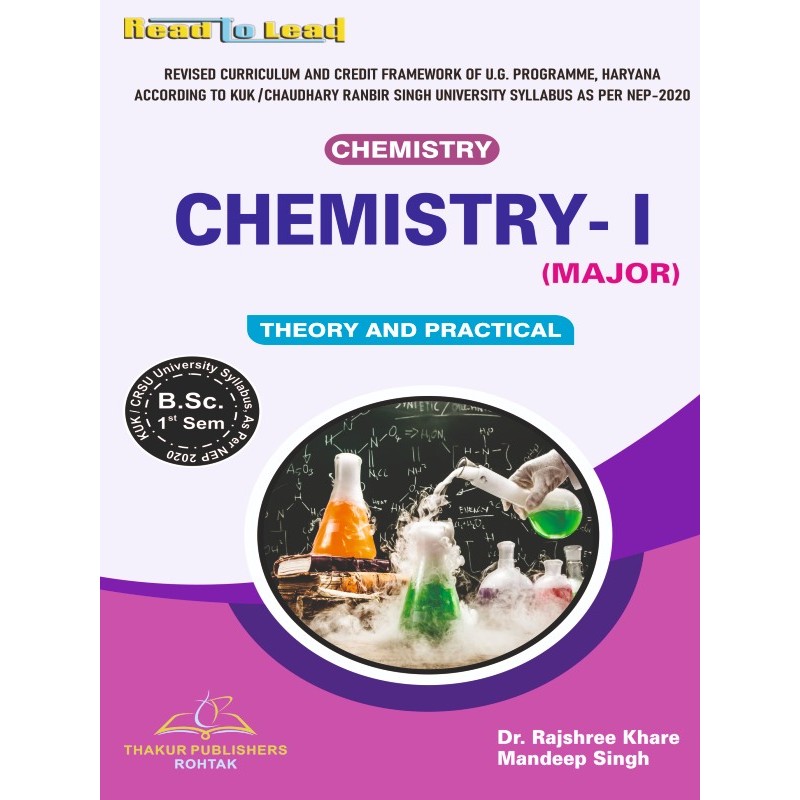


Click below to Buy E-Book Edition:
AUTHORS: Dr. Rajshree Khare,Mandeep Singh
ISBN : 9789357555500
Syllabus
Chemistry-I
Course Code: B23-CHE-101
|
Unit |
Topics |
Contact Hours |
|
I |
Atomic Structure Dual behaviour of matter and radiation, de Broglie’s relation, Heisenberg’s uncertainty principle, concept of atomic orbitals, significance of quantum numbers, radial and angular wave functions, normal and orthogonal wave functions, significance of , shapes of s, p, d, f orbitals, Rules for filling electrons in various orbitals, effective nuclear charge, Slater’s Rules. Periodic Table and Atomic Properties Classification of periodic table, definition of atomic and ionic radii, ionisation energy, electron affinity and electronegativity, trend in periodic table (in s and p-block elements), Pauling, Mulliken, Allred Rochow and Mulliken Jaffe’s electronegativity scale, Sanderson’s electron density ratio. |
12 |
|
II |
Gaseous State Kinetic theory of gases, Maxwell’s distribution of velocities and energies (derivation excluded) Calculation of root mean square velocity, average velocity, and most probable velocity. Collision diameter, collision number, collision frequency and mean free path (Derivations excluded), Deviation of Real gases from ideal behaviour, Derivation of Van der Waal’ s Equation of State, its application in the calculation of Boyle’ s temperature (compression factor). Critical Phenomenon Concept of Critical temperature, critical pressure, critical volume, relationship between critical constants and Van der Waal’ s constants (Derivation excluded). |
11 |
|
III |
Structure and Bonding Localised and delocalized chemical bond, Van der Waals interactions. Concept of resonance and its applications, hyperconjugation, inductive effect, Electrometric effect and their comparison. Mechanism of Organic Reactions Curved arrow notation, homolytic and heterolytic bond fission. Types of reagents: electrophiles and nucleophiles. Types of organic reactions – Substitution, Addition, Condensation, Elimination, Rearrangement, Isomerization and Pericyclic reactions. Reactive intermediates – Carbocations, carbanions, free radicals, carbenes (structure and stability). |
11 |
|
IV |
Liquid State Structure of liquids, Properties of liquids – surface tension, refractive index, viscosity, vapour pressure and optical rotation. Solid State Classification of solids, Law of constancy of interfacial angles, Law of rational indices, Miller indices, Elementary ideas of symmetry and symmetry elements, Seven crystal systems and fourteen Bravais lattices – X-ray diffraction, Bragg’s law, A simple account of Laue method, Rotating crystal method and powder pattern method. |
11 |
|
V |
1) Acid/Base Titration: Determination of strength of oxalic acid using NaOH. 2) Redox Titrations: Determination of ions using KMnO4. 3) To determine the surface tension of given liquid using Stalagmometer by drop no. methods. 4) Preparation of m-Dinitrobenzene from Nitrobenzene (use 1:2 conc. HNO3-H2SO4 mixture if fuming HNO3 is not available) 5) Preparation of p-Bromoacetanilide from Acetanilide |
30 |
Specific References
Click below to Buy E-Book Edition:
AUTHORS: Dr. Rajshree Khare,Mandeep Singh
ISBN : 9789357555500