
- New
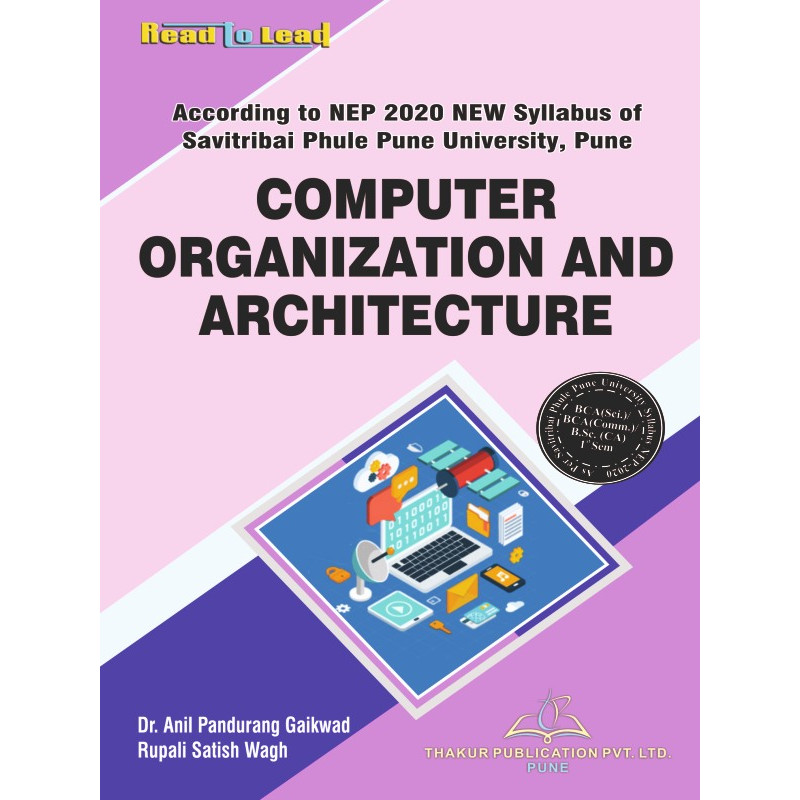


Authors : Dr. Anil Pandurang Gaikwad, Mrs. Rupali Satish Wagh
ISBN : 9789357557160
Syllabus
Computer Organization and Architecture
Course Code: CA – 103 – T
BCA (Science)
|
Unit
|
Contents
|
Hours
|
|
1
|
Data representation and Computer Arithmetic
Review of Decimal, Binary, Octal, Hexadecimal Number systems and their inter-conversion, BCD code, Gray code, Excess-3 code, ASCII , EBCDIC, Unicode, Signed and Unsigned numbers, 1’s and 2’s complements, Binary arithmetic. |
04
|
|
2
|
Boolean Algebra & Logic Gates
Boolean theorems, Boolean Laws, De Morgan’s Theorem, Reduction of Logic expression using Boolean Algebra, Introduction to Logic (AND, OR, NOT), Classification of Logic gates, Universal Logic gates, Implementation of other gates using universal gates. Basic concepts of Karnaugh map, minterm and maxterm. |
07
|
|
3
|
Combinational Circuits
Definition of combinational circuits, Detail study of Half adder, Full adder, Half subtractor, Full subtractor, Multiplexer (4:1) & Demultiplexer(1:4), Encoder (8-line-to- 3-line) and Decoder (3-line-to-8-line), Parity generator and checker, Block diagram of ALU.
|
07
|
|
4
|
Sequential Circuits
Definition of sequential circuits, Detail study of Flip Flops and truth tables: S-R FF, JK FF, T and D type FFs, Flip flop as memory device. Counters: Asynchronous-Mod16, Mod-10, Mod-8, up down counter, Synchronous- Ring counter, Event counter. Shift Registers and their types, serial to parallel and parallel to serial converters using shift registers.
|
07
|
|
5
|
CPU, Memory and I/O Organization
Block diagram of CPU, functions of CPU, general register organization, flags, Concept of RISC and CISC Memory System hierarchy, Cache Memory, Internal Memory, External Memory, Concept of Virtual Memory. Basics of I/O Organisation: types of I/O data transfers.
|
05
|
Syllabus
Computer Organization and Architecture
Course Code: CA – 103 – T
BCA (Commerce)
|
Unit
|
Contents
|
Hours
|
|
1
|
Data representation and Computer Arithmetic
Review of Decimal, Binary, Octal, Hexadecimal Number systems and their inter-conversion, BCD code, Gray code, Excess-3 code, ASCII , EBCDIC, Unicode, Signed and Unsigned numbers, 1’s and 2’s complements, Binary arithmetic. |
04
|
|
2
|
Boolean Algebra & Logic Gates
Boolean theorems, Boolean Laws, De Morgan’s Theorem, Reduction of Logic expression using Boolean Algebra, Introduction to Logic (AND, OR, NOT), Classification of Logic gates, Universal Logic gates, Implementation of other gates using universal gates. Basic concepts of Karnaugh map, minterm and maxterm. |
07
|
|
3
|
Combinational Circuits
Definition of combinational circuits, Detail study of Half adder, Full adder, Half subtractor, Full subtractor, Multiplexer(4:1) & Demultiplexer(1:4), Encoder (8-line-to- 3-line) and Decoder (3-line-to-8-line), Parity generator and checker, Block diagram of ALU. |
07
|
|
4
|
Sequential Circuits
Definition of sequential circuits, Detail study of Flip Flops and truth tables: S-R FF, J- K FF, T and D type FFs, Flip flop as memory device. Counters: Asynchronous-Mod16, Mod-10, Mod-8, up down counter, Synchronous- Ring counter, Event counter. Shift Registers and their types, serial to parallel and parallel to serial converters using shift registers. |
07
|
|
5
|
CPU, Memory and I/O Organization
Block diagram of CPU, functions of CPU, general register organization, flags, Concept of RISC and CISC. Memory System hierarchy, Cache Memory, Internal Memory, External Memory, Concept of Virtual Memory. Basics of I/O organisation: types of I/O data transfers. |
05
|
Syllabus
Computer Organization and Architecture
Course Code: CA – 103 – T
B.Sc. (CA)
|
Unit
|
Contents
|
Hours
|
|
1
|
Data Representation and Computer Arithmetic
Review of Decimal, Binary, Octal, Hexadecimal Number systems and their inter-conversion, BCD code, Gray code, Excess-3 code, ASCII , EBCDIC, Unicode, Signed and Unsigned numbers, 1’s and 2’s complements, Binary arithmetic.
|
04
|
|
2
|
Boolean Algebra & Logic Gates
Boolean theorems, Boolean Laws, De Morgan’s Theorem, Reduction of Logic expression using Boolean Algebra, Introduction to Logic (AND, OR, NOT), Classification of Logic gates, Universal Logic gates, Implementation of other gates using universal gates. Basic concepts of Karnaugh map, minterm and maxterm.
|
07
|
|
3
|
Combinational Circuits
Definition of combinational circuits, Detail study of Half adder, Full adder, Half subtractor, Full subtractor, Multiplexer(4:1) & Demultiplexer(1:4), Encoder (8-line-to- 3-line) and Decoder (3-line-to-8-line), Parity generator and checker, Block diagram of ALU. |
07
|
|
4
|
Sequential Circuits Definition of sequential circuits, Detail study of Flip Flops and truth tables: S-R FF, J- K FF, T and D type FFs, Flip flop as memory device. Counters: Asynchronous-Mod16, Mod-10, Mod-8, up down counter, Synchronous - Ring counter, Event counter. Shift Registers and their types, serial to parallel and parallel to serial converters using shift registers. |
07
|
|
5
|
CPU, Memory and I/O Organization
Block diagram of CPU, functions of CPU, general register organization, flags, Concept of RISC and CISC Memory System hierarchy, Cache Memory, Internal Memory, External Memory, Concept of Virtual Memory. Basics of I/O organisation: types of I/O data transfers |
05
|
Authors : Dr. Anil Pandurang Gaikwad, Mrs. Rupali Satish Wagh
ISBN : 9789357557160