
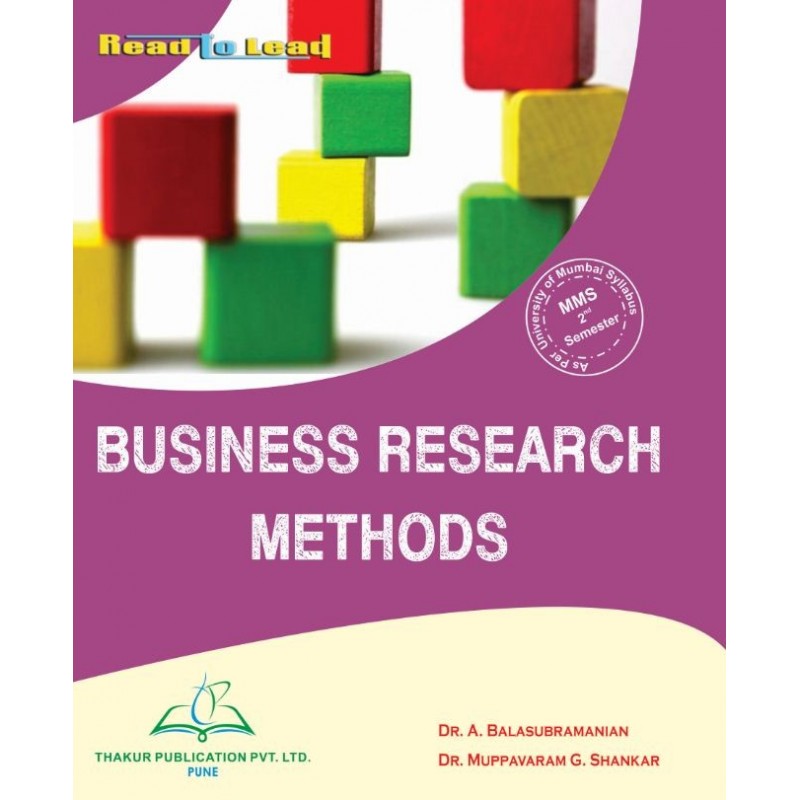


Dr. Muppavaram Gowri Shankar and A. Balasubramanian
ISBN-9789351634461
| Module | Content | Learning Outcomes |
| 1 | Introduction to Research | Meaning of research; Types of research- Exploratory research, Conclusive research; The process of research; Research applications in social and business sciences; Features of a Good research study. |
| 2 | Research Problem and Formulation of ResearchHypotheses | Defining the Research problem; Management Decision Problem vs Management Research Problem; Problem identification process; Components of the research problem; Formulating the research hypothesis- Types of Research hypothesis; Writing a research proposal- Contents of a research proposal and types of research proposals. |
| 3 | Research Design | Meaning of Research Designs; Nature and Classification of Research Designs; Exploratory Research Designs: Secondary Resource analysis, Case study Method, Expert opinion survey, Focus group discussions; Descriptive Research Designs: Cross sectional studies and Longitudinal studies; Experimental Designs, Errors affecting Research Design. |
| 4 | Primary and Secondary Data | Classification of Data; Secondary Data: Uses, Advantages, Disadvantages, Types and sources; Primary Data Collection: Observation method, Focus Group Discussion, Personal Interview method. |
| 5 | Attitude; Measurement and Scaling | Types of Measurement Scales; Attitude; Classification of Scales: Single item vs Multiple Item scale, Comparative vs Non-Comparative scales, Measurement Error, Criteria for Good Measurement. |
| 6 | Questionnaire Design | Questionnaire method; Types of Questionnaires; Process of Questionnaire Designing; Advantages and Disadvantages of Questionnaire Method. |
| 7 | Sampling and Data Processing | Sampling concepts- Sample vs Census, Sampling vs Non Sampling error; Sampling Design- Probability and Non Probability Sampling design; Determination of Sample size- Sample size for estimating population mean, Determination of sample size for estimating the population proportion.Data Editing- Field Editing, Centralized in house editing; Coding- Coding Closed ended structured Questions, Coding open ended structured Questions; Classification and Tabulation of Data. |
| 8 | Univariate and Bivariate Analysis of Data | Descriptive vs Inferential Analysis, Descriptive Analysis of Univariate data- Analysis of Nominal scale data with only one possible response, Analysis of Nominal scale data with multiple category responses, Analysis of Ordinal Scaled Questions, Measures of Central Tendency, Measures of Dispersion; Descriptive Analysis of Bivariate data. |
| 9 | Testing of Hypotheses | Concepts in Testing of Hypothesis – Steps in testing of hypothesis, Test Statistic for testinghypothesis about population mean; Tests concerning Means- the case of single population; Tests for Difference between two population means; Tests concerning population proportion- the case of single population; Tests for difference between two population proportions. |
| 10 | Chi-square Analysis | Chi square test for the Goodness of Fit; Chi-square test for the independence of variables;Chi square test for the equality of more than two population proportions. |
| 11 | Analysis of Variance | Completely randomized design in a one-way ANOVA; Randomized block design in two way ANOVA; Factorial design. |
| 12 | Research Report Writing and Ethics in Research | Types of research reports – Brief reports and Detailed reports; Report writing: Structure ofthe research report- Preliminary section, Main report, Interpretations of Results and Suggested Recommendations; Report writing: Formulation rules for writing the report: Guidelines for presenting tabular data, Guidelines for visual Representations. Meaning of Research Ethics; Clients Ethical code; Researchers Ethical code; Ethical Codes related to respondents; Responsibility of ethics in research. |
| 13 | Presentation /Report |
Specific References
Dr. Muppavaram Gowri Shankar and A. Balasubramanian
ISBN-9789351634461